Sunday, February 22, 2015

DIAGNOSTIC INSTRUMENTS 2


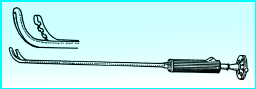
         •       Naughton Morgan rectal speculum (Fig. 8.134)
         •       McEvedy rectal speculum (Fig. 8.135)
         •       Heinkel sigmoidoscope (Fig. 8.136)
         •       Llyod Davies sigmoidoscope (Fig. 8.137)
         •       Olympus adult cystoscope (Fig. 8.138).

Any questions be sent to drmmkapur@gmail.com
All older posts are stored in archives for access and review.
Visitors that follow may post contributions to the site,please write to address above.
To create consumer/provider engagement visit www.surgseminar.blogspot.com

Sunday, February 15, 2015

DIAGNOSTIC INSTRUMENTS 1


Diagnostic Instruments
These are instruments for viewing lumens of hollow organs.
         Those in use are:
         •       Anesthetic laryngoscope (Fig. 8.129)
         •       Macintosh laryngoscope blade (Fig. 8.130)
         •       Negus laryngoscope (Fig. 8.131)
         •       Negus esophagoscope (Fig. 8.132)
         •       Olympus esophago-gastro-duodenoscope (Fig. 8.133)

Any questions be sent to drmmkapur@gmail.com
All older posts are stored in archives for access and review.
Visitors that follow may post contributions to the site.please write to address above.
To create consumer/provider engagement visit www.surgseminar.blogspot.com

Sunday, February 8, 2015

Other Special Instruments 2


         •       Joll aneurysm needle (Fig. 8.122)
         •       Syme aneurysm needle (Fig. 8.123)
         •       Satinsky clamp (Fig. 8.124)
         •       DeBakey aortic clamp (Fig. 8.125)
         •       Mini bulldog clamp (Fig. 8.126)
         •       Varicose stripper (Fig. 8.127)
         •       Dissectors (Mac Donald/Durham/Watson-Cheyne) (Fig. 8.128).

Any questions be sent to drmmkapur@gmail.com
All older posts are tored in archives for access and review.
Visitors that follow may post contributions to the site,please write to address above.
To create consumer/provider engagement visit www.surgsreminar.blpgspot.com

Sunday, February 1, 2015

Other Special Instruments 1


         The other special instruments in use are:
         •       Thompson lithotrite (Fig. 8.117)
         •       Turner Warwick calculus foreceps (Fig. 8.118)
         •       Rendal renal calculus forceps (Figs 8.119A to C)
         •       Millins boomrang needle (Fig. 8.120)
         •       Dupuytren’s aneurysm needle (Fig. 8.121)
Any questions be sent to drmmkapur@gmail.com
All older posts are stored in archives for access and review.
Visitors tha follow may post contributions to the site,please write to address above.
To create consumer/provider engagement visit www.surgseminar.blogspot.com


Monday, January 26, 2015

SPECIAL INSTRUMENTS


Special Instruments
To obtain tissue for histopathologic examination is an important part of a surgeon’s functions. Scrappings from cavities are obtained by Volkmann Scoop and Sims uterine curet. Menghini needle and Silverman needle obtain access through unbroken skin and Walton rectal biopsy forceps and Chevalier Jackson biopsy forceps are for obtaining biopsy material under vision through proctoscope or a sigmoidoscope.
         Biopsy instruments are used for obtaining material for histologic examination and those in use are:
•       Volkmann’s scoop (Fig. 8.112)
•       Sim’s uterine curet (Fig. 8.113)
•       Menghini needle (Fig. 8.114)
•       Silverman needle (Fig. 8.115)
•       Chevalier-Jackson biopsy forceps (Fig. 8.116)

Any questions be sent to drmmkapur@gmail.com
All older posts are stored in archives for access and review.
Visitors that follow may post contributions to the site,please write to address above.
To create consumer/provider engagement please visit www.surgseminar.blogspot.com

Sunday, January 18, 2015

DILATORS & PROBES 2


Probes and Dilators
Probes are used to gain entry to small (openings) to get information about their depth, direction and size; they are usually blunt ended.
Dilators are used to investigate the patency and dilate hollow tubular passages.
         Infection trauma and surgical accidents can result in healing by second intention in hollow organs this result in strictures.
         In the past these strictures have been treated by dilatation.
         The dilators have been made of metal or gum elastic. The agreed gauge has been utilized to ensure uniform size in all the sets.
         This also helps the surgeon to choose the correct sized dilator. As dilatations are done gradually over a period of the time, the surgeon records the degree of dilatation achieved so as to start at the next level on the subsequent attendance.
         Corticosteroids can also be used to minimum edema and fibrosis.
         The dilators in use are:
         •       Lister (Fig. 8.106A)
         •       Clutton (Fig. 8.106B)
         •       Tuner-Warwick (Fig. 8.107)
         •       Canny Ryall bougie (Fig. 8.108)
         •       Jackson esophageal bougie (Fig. 8.109)
         •       Neoplex (Fig. 8.110)
         •       Bake’s bile duct (Fig. 8.111).
Any questions be sent to drmmkapur@gmail.com
All older posts are stored in archives for access and review.
Visitors that follow may post contributions to the site,please write to address above.
to create consumer/provider engagement visit www.surgseminar.blogspot.com

Monday, January 12, 2015

PROBES & DILATORS 1


Probes and Dilators
Probes are used to gain entry to small (openings) to get information about their depth, direction and size; they are usually blunt ended.
Dilators are used to investigate the patency and dilate hollow tubular passages.
         Infection trauma and surgical accidents can result in healing by second intention in hollow organs this result in strictures.
         In the past these strictures have been treated by dilatation.
         The dilators have been made of metal or gum elastic. The agreed gauge has been utilized to ensure uniform size in all the sets.
         This also helps the surgeon to choose the correct sized dilator. As dilatations are done gradually over a period of the time, the surgeon records the degree of dilatation achieved so as to start at the next level on the subsequent attendance.
         Corticosteroids can also be used to minimum edema and fibrosis.
         The dilators in use are:
         •       Lister (Fig. 8.106A)
         •       Clutton (Fig. 8.106B)
         •       Tuner-Warwick (Fig. 8.107)

Any questions be sent to drmmkapur@gmail.com
Allolder posts are stored in archives for access and review.
Visitors that follow may contributions to the site,please write to address above.
to create consumer/provider engagement visit www.surgseminar.blogspot.com
www.drmmkapur.blogspot.com       www.otmanage.blogspot.com