Wednesday, December 14, 2016

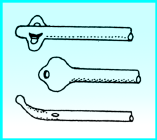
Genral surgery instruments skin hook retrators


Skin-Hooks and Retractors
Examples are:
•       Gillies skin hook
•       McIndoe skin hook
•       Kilner’s skin retractor
•       Alms skin retractor

Any questions be sent to drmmkapur@gmail.com
All older posts are stored in archives for access and review.
Visitors that follow may post contributions to the site,please write to address above.
To create consumer/providerengagement visit www.drmmkapur.blogspot.com
These posts also available on android &other smartphones same internet address 

Wednesday, December 7, 2016

Geraral Surgery Instruments Self retaining retractors


Self-retaining retractors, i.e. Travers, Norfolk, Norwich, Balfours, Alms and Jolls have atleast two blades joined by a hinge joint or bar. It is thus possible to create lateral pressure against both margins of the wound. This helps to retain the retractor in position throughout the duration of the operation. 
         Thus freeing the hands of the assistant for assisting the surgeon in other ways. 
         Examples are:
         •       Travers (Fig. 8.98) 
         •       Norfolk (Fig. 8.99) 
         •       Balfour abdominal (Fig. 8.100) 
         •       Joll thyroid (Fig. 8.101).

Any questions be sent to drmmkapur@gmail.com
All older posts are stored in archives for access and review.
Visitors that follow may post contributions to the site,please write to address above.
To create consumer/providerengagement visit www.drmmkapur.blogspot.com
These posts also available on android &other smartphones same internet address.

Thursday, December 1, 2016

Genral SURGERY INSTRUMENTS WOUND RETRACTORS


Wound Retractors
Good exposure is one of the requisites of successful surgery. Instruments designed specifically to improve exposure are called wound retractors. They can be hand-held or self-retaining. 
         The handle of the retractor is held by the assistant the retracting end is usually at a right angle to this. It smooth rounded with no sharp corner or edges to avoid injury to the tissues. The use of the retractor can be estimated from the depth to which this retracting end can go. 
         The varieties in use are: 
         •       Langenbeck  
         •       Ollier  
         •       Morris  
         •       Kelly  
         •       Deaver  
         •       Lloyd Davies  
         •       Czerny  
         •       Allison lung

Any questions be sent to drmmkapur@gmail.com
All older posts are stored in archives for access and review.
Visitors that follow may post contributions to the site,please write to address above.
To create consumer/providerengagement visit www.drmmkapur.blogspot.com
These posts also available on android &other smartphones same internet address. 

Tuesday, November 22, 2016

General Surgery Instruments Catheters & drains


Catheters
The Foley catheter is a plastic two-lumen tube with an inflatable balloon. The balloon is inflated via a small channel.
     Suprapubic cystostomy is an alternative way of draining the urinary bladder. The Malecot catheter is well suited for this purpose. It is a rubber or latex tube with two wings at the tip. The de Pezzer catheter is based on a similar principle except that instead of wings, it has a bulbous end which can be straightened and recoils back when the wire introducer is removed.
     The catheters used are:
        Foley 
        Gibbons 
        Malecot 
        DePezzer 
        Tiemann 
        Secured tube drains 

        Corrugated

Any questions be sent to drmmkapur@gmail.com
All older posts are stored in archives for access and review.
Visitors that follow may post contributions to the site,please write to address above.
To create consumer/providerengagement visit www.drmmkapur.blogspot.com
These posts also available on android &other smartphones same internet address.

Wednesday, November 16, 2016

General Surgery Tubes 2


Nasogastric
Tubes may have to be passed into the stomach, or even beyond, for decompression, sampling or delivery of drugs or food. 
         Ryle’s tube is most commonly used for decompression of the stomach following abdominal surgery or for intestinal obstruction.
         The other tubes used are:
         •       Nasogastric  
         •       Sengstaken

Any questions be sent to drmmkapur@gmail.com
All older posts are stored in archives for access and review.
Visitors that follow may post contributions to the site,please write to address above.
To create consumer/providerengagement visit www.drmmkapur.blogspot.com
These posts also available on android &other smartphones same internet address

Wednesday, November 9, 2016

General Surgery Tubes Catheters


Tubes and Catheters and Drains
Tubes
Without endotracheal tubes modern anesthesia would be unthinkable. The traditional tubes of the Magill pattern are made of red mineralized rubber. Except for the smallest they all have an inflatable cuff near the distal tip to protect the lower respiratory tract form soiling as well as providing an air-tight seal. Each number refers to the internal diameter of the tube in millimeters.
         All tubes in the past have been made of rubber and have been recycled in practice by autoclaving. All these instruments and nasogastric tubes are now made of nonreactive plastic material and come presterilized in packs. These tubes are all disposable and thus do not require recycling. 
         The tubes in use are:
         •       Endotracheal  
         •       Uncuffed oral endotracheal tube  
         •       Negus tracheostomy  
         •       Chevalier Jackso.

Any questions be sent to drmmkapur@gmail.com
All older posts are stored in archives for access and review.
Visitors that follow may post contributions to the site,please write to address above.
To create consumer/providerengagement visit www.drmmkapur.blogspot.com
These posts also available on android &other smartphones same internet address 

Wednesday, November 2, 2016

General Srgery Needle straight curved cutting edge


Needles (Straight and Curved) and Sutures
Round Bodied
Cutting  Cutting edge needles have sharp edges commencing at the point and prolonged along their shafts to help them penetrate dense tough tissues such as skin or tendon. Shapes of needles are shown i.
Sutures  Sutures may be organic, synthetic or metallic in origin. Their characteristics and indications are discussed in detail

Any questions be sent to drmmkapur@gmail.com
All older posts are stored in archives for access and review.
Visitors that follow may post contributions to the site,please write to address above.
To create consumer/providerengagement visit www.drmmkapur.blogspot.com


These posts also available on android &other smartphones same internet address